
How Surgeons Learn One of Medicine's Precise Procedures
Redefine How Surgeons Learn One of Medicine's Precise Procedures
Written by: CITL'S Killivalavan (Killi) Solai and Alexander (Alex) Dill
Photos by: CITL's Alexander (Alex) Dill, Andrew Phanor, and Jacob Beinborn
Remarkable innovations often begin with a simple conversation, not a grand plan. At the Center for Innovation in Teaching & Learning (CITL) at the University of Illinois Urbana-Champaign, such a conversation started the XR Liver Surgery project that can redefine how surgeons learn one of medicine's most precise procedures.
“A deep understanding of three-dimensional anatomy has traditionally required significant time and has remained a major barrier not only in surgical education but also in inspiring and training the next generation of surgeons.”
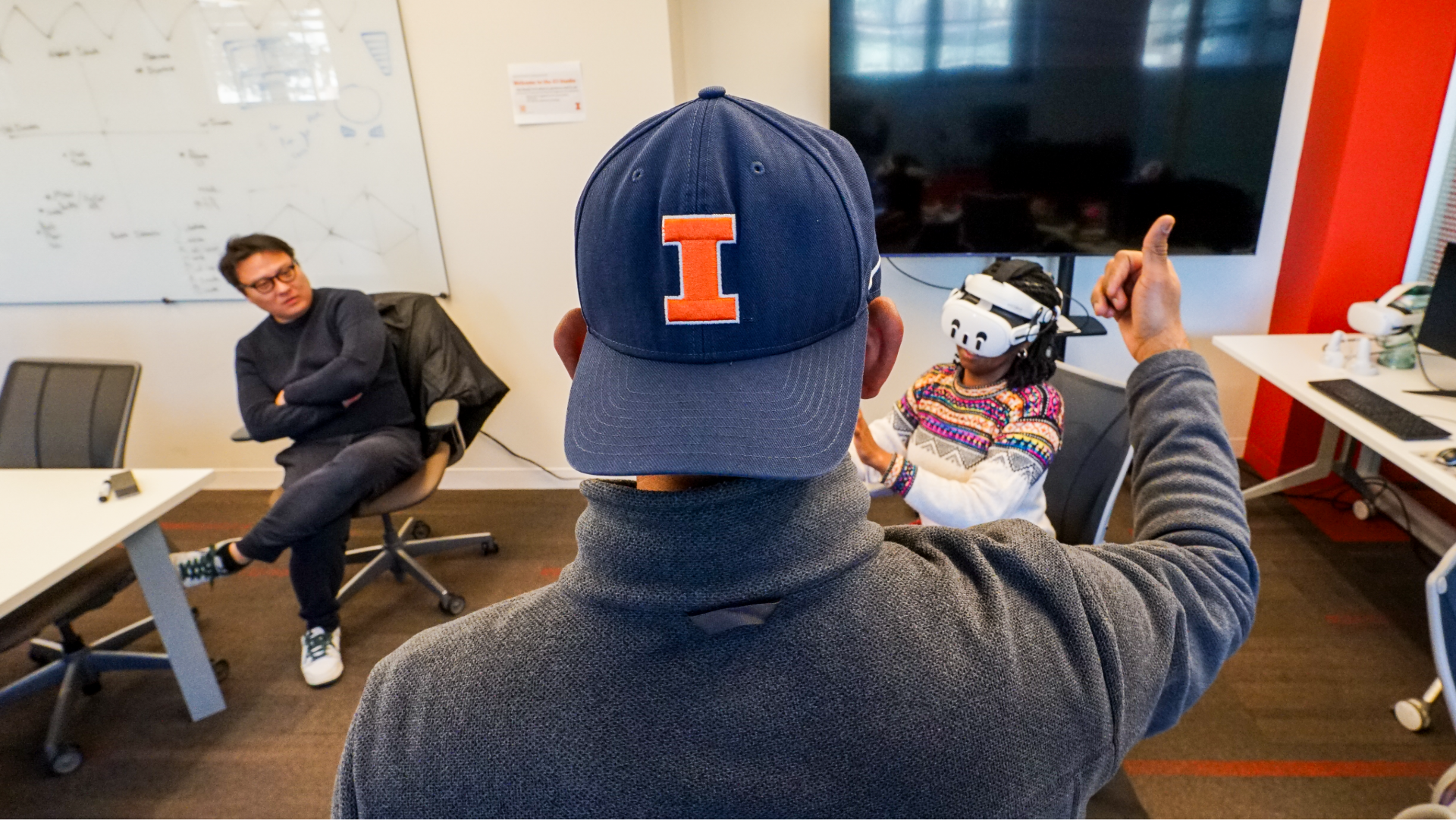
CITL Digital Art Director Killivalavan Solai observes with Dr. Fumihiro Kawano during user testing in the X3 Studio.
A Request, A Partnership, Then Publication
Dr. Claudius Conrad, Phyllis M. Wise Professor of Medicine and Innovation and Associate Dean for Research and Innovation at Carle Illinois College of Medicine, reached out to Michel Bellini, CITL's Director, with a specific request for a scientific animation to accompany a research publication in the Annals of Surgical Oncology. The subject was cone-based liver resection, a sophisticated surgical technique widely practiced in Japan but still uncommon in North America and Europe.
As the lead researcher and expert surgeon on the precision surgery project, Dr. Kawano brought deep clinical expertise and a clear vision that guided the collaboration from the outset. Cone-based preoperative liver surgery is an advanced planning approach for complex liver operations, especially when removing tumors or diseased tissue. Compared to traditional sectionectomy, it allows surgeons to precisely target and remove only the affected area while preserving more healthy liver tissue, improving both safety and postoperative outcomes.
Soon after the initial request, Dr. Kawano met with Michel and Killi Solai, the Digital Art Director at CITL, to begin work on it. Tim Brummett, Visual Media Designer at CITL, also worked closely with Dr. Kawano through an iterative process to create a scientifically accurate, visually compelling, and publication-ready animation. The animation accompanied the journal article and helped introduce a consequential surgical technique to an international audience in the prestigious Annals of Surgical Oncology.
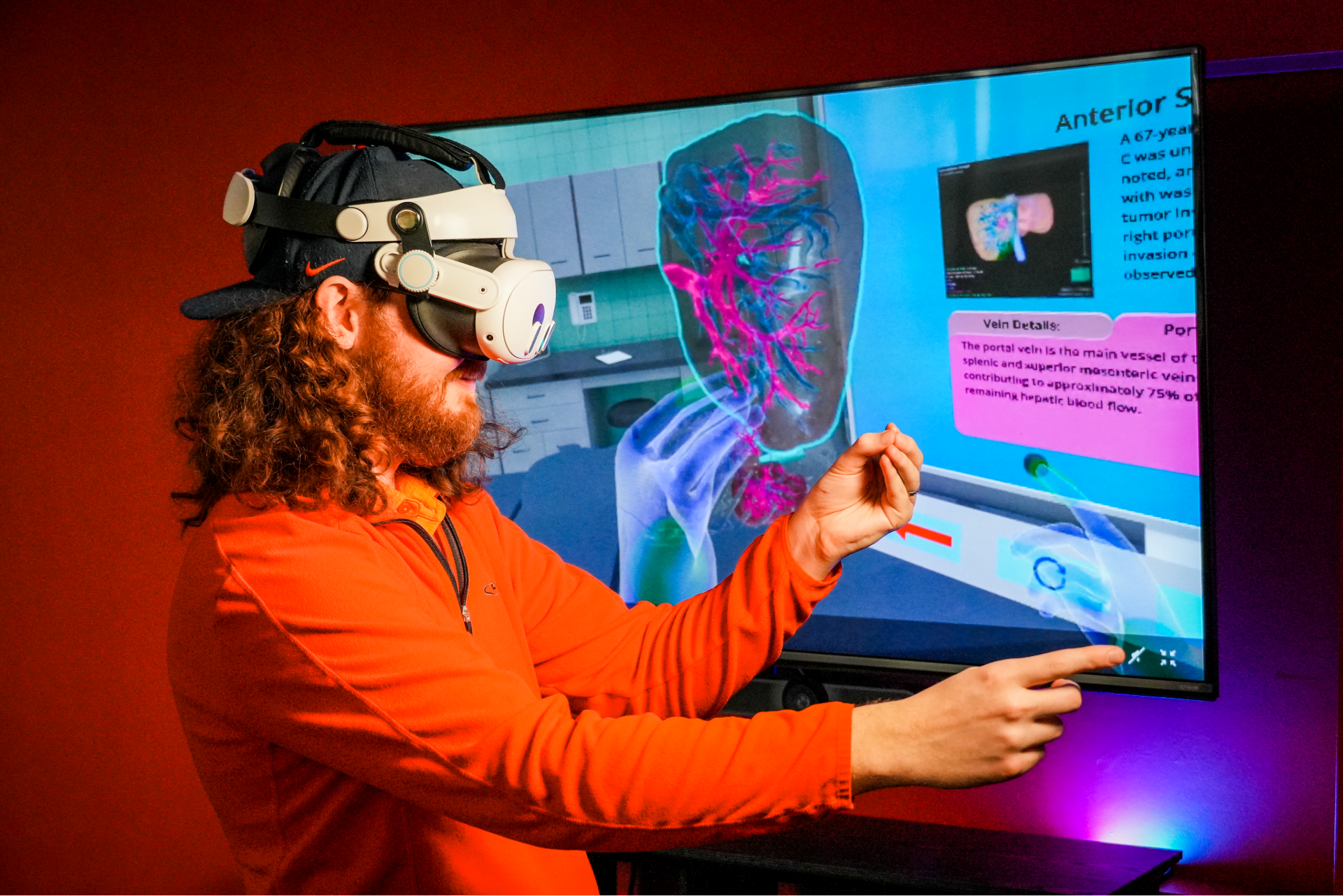
CITL VR Developer Alex Dill demonstrates the ways that the liver can be manipulated in the VR space. Here he showcases the ways that the application allows users to observe the inner structure of the liver.
The Moment Everything Expanded
In a candid yet curious exchange near the project's end, a simple question shifted the trajectory of the project. The current animation was effective, but could the technique be taught more powerfully? Could learners do more than watch? Could they actively engage in surgery?
These questions became the foundation for the XR Precision Liver Surgery Learning and Training Simulator. For Dr. Kawano, the potential was immediate. After years of advancing this technique, an immersive simulator offered a way to extend that knowledge globally from textbook to actual, real-time application. This is where CITL's collaborative philosophy does not stop with the original request; the team stays curious alongside each partner, co-creating and co-innovating throughout projects.
Turning The Vision Into Reality
Building something extraordinary required assembling the right expertise and thoughtful technical decisions throughout the project process. Killi took the lead on this project with an amazing team, with Alex Dill, CITL's XR designer and developer, to build a project prototype; Shambhavi Joshi, Associate Project Manager, Gies College of Business, as the product manager to guide the project strategically; and Xiaoyue Feng, a 3D artist from the School of Visual Arts in New York, developed detailed anatomical models and environments. Drew Fast (Visual Media Design Specialist) and Tim Brummett contributed as design consultants.
The initial plan of the team was to develop the simulator on Unreal Engine, a powerful game development platform. But Alex proposed creating a proof-of-concept in Godot, a lean open-source alternative, before committing to an Unreal build. Alex's instinct proved prescient, and the team is currently building the entire application on Godot. While Unreal often requires starting with a large, feature-rich system and scaling down, Godot allowed the team to build from the ground up, adding only what was necessary. The result was a highly efficient standalone headset application that performs smoothly without compromising on the visual fidelity. These intentional design choices can be seen in each and every aspect of this XR application that runs entirely controller-free. This creates an intuitive and immersive experience that feels less like software and more like a spatial learning environment. Users can also switch between a fully immersive VR mode and an XR pass-through mode, allowing for both educational roleplay and user-conscious accessibility. Importantly, the liver models are based on real patient CT scan data with identifying details removed, ensuring both realism and authenticity.
“This project demonstrates how XR can become a game-changer by enabling immersive, interactive learning anytime and anywhere, expanding access beyond geographic boundaries, and transforming how surgeons learn complex anatomy.”
CITL XR Developer Alex Dill demonstrates the LiverVR application.
A Tool with Global Potential
The implications of this XR Liver Surgery simulator extend beyond a single university or a single specialty. Surgical education has traditionally depended on proximity to experienced mentors and expert training. XR technology has the potential to remove those barriers. A resident in Chicago, a surgeon in Tokyo, or a medical student in Nairobi could all access the same high-quality training environment.
For patients, this could be a major benefit. Better-trained surgeons produce better outcomes! This tool, if implemented, can elevate the standard of surgical education and has the potential to elevate the standard of surgical care.
The XR Precision Liver Surgery Learning and Training Simulator is still being built, but its origins at the Center for Innovation in Teaching & Learning at the University of Illinois Urbana-Champaign already demonstrate what happens when talented people stay curious with their clients throughout a project, both co-creating and co-innovating to make a global impact!