
UDL Tip of the Month 2026

2026 UDL Tip of the Month Articles
Welcome to the Universal Design for Learning (UDL) Tip of the Month series!
Each month, we share practical strategies and insights to help educators design more inclusive and accessible learning experiences. These tips are grounded in UDL principles and provide concrete, actionable guidance on fostering engagement, representation, and expression in your courses. Explore the 2026 monthly tip articles below to discover new ways to support all learners!

Cutting Through the Noise to Build Better Choice Rubrics
By Marc Thompson
One of the most common challenges instructors encounter when offering Multiple Means of Action and Expression is not coming up with assignment options, it's designing a single rubric that works well across all of them (Thompson, 2024). When students can choose between an essay, a presentation, a podcast, or another format, instructors often struggle to identify criteria that are equally relevant to every assignment option. In situations like this, rubrics can sometimes drift toward format-specific features, or instructors cave and create separate rubrics for each assignment option. Either way, consistency tends to suffer.
This is where thinking in terms of signal-to-noise ratio can be especially useful. Signal-to-noise thinking can help instructors identify which criteria should remain constant across formats because they reflect the learning outcomes, and which criteria are better treated as flexible, contextual, or secondary.
Signal, Noise, and Rubric Design
In educational assessment, the "construct" is the specific knowledge, skill, or capability an assessment is intended to measure (Messick, 1989). That construct is the "signal." A well-designed rubric makes that signal visible and stable across student work. The difficulty is that student submissions often include additional demands that are not central to the construct: time constraints, tool fluency, familiarity with genre conventions, or comfort with specific modes of communication. These factors can introduce "noise," not because they are unimportant in general, but because they aren't always relevant to what the assignment is meant to assess.
When instructors design rubrics for multiple submission options, this noise can become especially pronounced. Criteria that work well for one format may feel awkward, irrelevant, or overly restrictive for another. Signal-to-noise thinking provides a way through that problem. It starts by identifying the signal, then designing rubric criteria that capture that signal in ways that apply across formats (CAST, 2018; Meyer et al., 2014). A "signal-first choice rubric" does exactly that. It anchors evaluation to the learning outcomes and uses the same core criteria for each of the assignment options, while at the same time allowing the form of students' action and expression to vary.
The sidebar checklist offers some strategic questions to keep in mind when designing a signal-first choice rubric. If each of those items can be answered confidently, the rubric is likely doing a good job of keeping the signal clear while allowing meaningful choice across a variety of assignment options.
Examples of Signal-First Choice Rubrics Across Disciplines
The following assignment examples illustrate how consistent, relevant rubric criteria can be applied across different submission formats without privileging one assignment option over another.
Example 1: History Assignment
Assignment Instructions
Students will develop an interpretive analysis of a historical question using primary sources. The submission must advance a defensible historical claim and support that claim through contextualized analysis of multiple primary sources. Students may choose one of the approved formats below. All formats will be evaluated using the same criteria.
Approved formats:
- An 8–10 page analytical essay
- A 12–15 minute narrated digital exhibit
- A structured podcast episode with an annotated source record
Signal-First Choice Rubric (History)
| Criterion | Exemplary | Proficient | Developing |
|---|---|---|---|
| Interpretive Claim | Advances a clear, original historical interpretation that drives the analysis | Presents a coherent interpretation with minor lapses | Relies largely on description or an implicit claim |
| Use of Primary Sources | Analyzes sources for perspective, purpose, and limitation | Uses sources appropriately with uneven analysis | Treats sources primarily as factual records |
| Contextualization | Situates sources convincingly within broader historical contexts | Provides relevant context with limited integration | Context is minimal or disconnected |
| Synthesis | Connects sources to each other in service of the argument | Some connections are made | Sources remain largely isolated |
| Scholarly Practice | Uses attribution and citation conventions appropriate to the medium | Minor inconsistencies in scholarly practice | Significant problems with attribution or framing |
In this rubric, scholarly practice is included because transparent use of evidence is part of the historical construct itself. Criteria remain relevant whether the work is written, narrated, or exhibited digitally.
Example 2: Biology Assignment
Assignment Instructions
Students will interpret experimental results from a provided dataset and explain what the data suggest about an underlying biological process. The submission must connect claims directly to evidence and demonstrate understanding of the experimental design. Students may choose one of the formats below.
Approved formats:
- A written Results and Discussion section
- A recorded research briefing with annotated figures
- An interactive lab report using R Markdown or Jupyter Notebook
Signal-First Choice Rubric (Biology)
| Criterion | Exemplary | Proficient | Developing |
|---|---|---|---|
| Data Interpretation | Accurately explains trends, variability, and anomalies | Identifies major patterns with minor errors | Misinterprets data or describes without analysis |
| Evidence-based Reasoning | Claims are explicitly tied to figures or statistics | Evidence is present but unevenly integrated | Claims are weakly supported |
| Experimental Design Awareness | Clearly explains controls, variables, and limitations | General awareness of design features | Limited or incorrect understanding |
| Biological Explanation | Uses appropriate biological mechanisms and models | Explanations are plausible but underdeveloped | Explanations are vague or inaccurate |
| Research Communication | Follows core conventions for presenting scientific results | Conventions mostly followed | Conventions interfere with interpretation |
Here, communication conventions are assessed because they support accurate interpretation of data. The same criteria apply across all formats, even though the presentation of results may differ substantially.
Example 3: Sociology Assignment
Assignment Instructions
Students will apply one or more sociological theories to analyze a contemporary social issue or case. The submission must demonstrate accurate theoretical application and sustained sociological reasoning. Students may select from the formats below.
Approved formats:
- An analytic paper
- A policy memo written for a defined stakeholder audience
- A recorded case analysis with a written analytic outline
Signal-First Choice Rubric (Sociology)
| Criterion | Exemplary | Proficient | Developing |
|---|---|---|---|
| Theoretical Application | Applies theory insightfully to explain social dynamics | Applies theory correctly with limited nuance | Theory is referenced but poorly applied |
| Analytical Depth | Examines causes, structures, and implications | Analysis present but uneven | Largely descriptive |
| Use of Evidence | Integrates course readings or empirical sources effectively | Uses relevant evidence | Evidence is minimal or disconnected |
| Argument Coherence | Develops a sustained sociological argument | Argument mostly coherent | Reasoning fragmented |
| Genre Awareness | Adapts tone and structure effectively to audience and purpose | Some genre awareness | Genre interferes with clarity |
In this example, genre awareness is assessed because sociological analysis often circulates in professional and public contexts. The criteria remain focused on sociological reasoning rather than format-specific polish.
Why Signal-to-Noise Matters for Choice Rubrics
Designing a rubric that works across multiple assignment options is difficult because formats vary. Signal-to-noise thinking offers a way to manage that complexity. By first identifying the construct and treating that as the stable signal, instructors can develop consistent, relevant criteria that apply across the different assignment options students are allowed to choose from. The result is a choice rubric that supports UDL's Multiple Means of Action and Expression while at the same time maintaining rigor, fairness, and alignment with stated learning outcomes. Ultimately, when the signal is clear and the noise is intentionally managed, both students and instructors have a better shared understanding of what counts as evidence of learning.
References
- CAST. (2024). The UDL Guidelines. http://udlguidelines.cast.org
- Messick, S. (1989). Validity. In R. L. Linn (Ed.), Educational Measurement (3rd ed., pp. 13–103). Macmillan.
- Meyer, A., Rose, D. H., & Gordon, D. (2014). Universal Design for Learning: Theory and Practice. CAST.
High Impact, Low Effort: Quick UDL Self-checks for Actionable Course Improvements
By Marc Thompson
Courses often grow in layers: new readings to fill gaps, longer assignment instructions to prevent confusion, and a seemingly never ending, expanding set of policies that accumulate to manage edge cases. Over time, these well-intentioned changes can unintentionally make learning harder by increasing cognitive load, obscuring priorities, or limiting how students engage. This month we consider some quick, targeted course self-checks that can help identify where course design creep may be creating friction.
Unlike the structured, long term reflection and revision cycles covered in last year's November UDL Tip of the Month article on instructor reflection and continuous improvement (Thompson, 2025a), UDL self-checks can help instructors evaluate existing course evidence to make quick, high-impact course adjustments. They are short, deliberate reviews that occur at strategic junctures like after a major assignment, mid-semester, or during course preparation. By seeking answers to practical questions like "Where is the course design creating friction that makes it harder than it needs to be right now?" UDL self-checks provide actionable insights without the time commitment of a full reflection cycle. At the same time, it's good to keep in mind that while self-checks are aimed at quick improvements, they can also contribute to broader, long term reflection cycles by helping instructors notice patterns now that they can target for more extensive redesign plans later (Iris Center, 2026).
It’s also important to distinguish UDL self-checks from accessibility checks, though the two can overlap in some ways. Accessibility reviews ensure technical requirements are met for optimizing access to digital content (e.g., heading structure, captioning, color contrast, screen-reader compatibility, etc.), while UDL self-checks focus more on inclusive practices that provide greater instructional clarity, flexibility, and engagement. In this context, a course may meet accessibility standards yet still present barriers if assignment choices are rigid or students don’t understand the purpose of various course activities. Think of UDL self-checks as quick diagnostic scans of learning experiences that complement accessibility reviews, rather than supplanting them. For more on this symbiotic relationship, see "UDL vs. Accessibility: What's the Difference and How Do They Work Together?" (Thompson 2025b).
Three Passes Through Your Course
A good catalyst for jump starting a UDL Self-check is to ask yourself "What part of my course currently requires the most explanation, and what design adjustment could reduce that overhead?" These questions help focus attention on areas most likely to create barriers for students. Once you have a general sense of where to look, you can work your way through a course scan in three targeted passes with each pass zeroing in on a different UDL instructional pathway.
Pass 1: Representation: Can Students Access and Interpret Key Ideas?
Self-check questions:
- Are key ideas available in multiple forms?
Example: Students struggling to follow a dense reading can also access a narrated slide summary or infographic. - Do complex materials include orientation or interpretive support?
Example: A dense history article is accompanied by a timeline, annotated glossary, and discussion guide. - Could students who miss class still grasp core ideas?
Example: Lecture recordings, short video summaries, and annotated lecture slides help students to catch up.
Where and how to look:
- LMS analytics: Are students quickly leaving dense reading pages?
- Discussion boards: Are posts focused on confusion about instructions rather than ideas?
- Email patterns: Are repeated clarification questions common?
- Assignment results: Do students miss questions tied to specific resources?
- Student reflections or surveys: Do they indicate misunderstanding of key concepts?
Examples of strategies to reduce representation barriers:
- Mathematics: Pair symbolic proofs with narrated explanations or step-by-step guided videos.
- Biochemistry: Combine pathway diagrams with short, written process summaries.
- History: Add guiding questions, contextual maps, and annotated primary sources.
- Sociology: Provide both theoretical diagrams and applied case study examples.
- Economics: Offer narrative walkthroughs of equations alongside symbolic formulations.
- Education: Present lesson examples alongside theoretical concepts, including short exemplars of classroom implementation.
- Computer Science: Provide code snippets with explanatory comments, plus flowcharts showing algorithm steps.
Pass 2: Action & Expression: Can Students Show Learning Without Format Barriers?
Self-check questions:
- Are all assessments in the same mode?
Example: Every unit uses timed essays, even when some questions could be answered via infographic, oral explanation, or interactive simulation. - Are instructions clear enough to avoid confusion?
Example: Students lose points for missing implied components like “cite at least two peer-reviewed sources.” - Could executive-function demands overshadow content goals?
Example: A multi-stage project requires students to plan topic, select format, and schedule milestones simultaneously, without guidance or scaffolding.
Where and how to look:
- Assignment submissions: Are multiple students misinterpreting the same instructions?
- Rubric comments: Are repeated clarifications needed across submissions?
- Choice patterns: Are certain options consistently avoided (e.g., no students choose the video option)?
- Office hours or discussion posts: Are logistical questions overshadowing conceptual questions?
- Peer review feedback: Are students struggling with mechanics instead of content?
Examples of strategies to reduce barriers to action & expression:
- Political Science: Allow analysis via briefing memo or short paper, with shared grading criteria.
- English Literature: Provide options for a close-reading, an annotated text, or a comparative analysis.
- Biology: Accept written explanations or narrated slide presentations with visuals.
- Engineering: Pair problem sets with short written reflections explaining design choices.
- Education: Allow critique of a lesson plan as a written template or annotated rubric.
Pass 3: Engagement: Can Students Sustain Effort and See Value?
Self-check questions:
- Where do students commonly disengage or fall behind?
- Do students understand why activities matter?
- Are pacing and effort expectations clear? Are students underestimating the time needed for assignments?
Where and how to look:
- Gradebook trends: Identify drop-offs in submissions.
- Late or missing work: Look for clustering around specific assignments or weeks.
- Discussion participation: Are there patterns of declining activity mid-term?
- Assignment descriptions: Is the task’s purpose explicitly stated?
- Student reflections, journal entries, or surveys: Do they reveal confusion about relevance or effort?
Examples of strategies to boost engagement:
- Statistics: Provide low-stakes practice sets or quick quizzes to reinforce learning.
- Chemistry: Break lab reports into staged submissions with feedback at each step.
- History: Ask students to relate themes to current events or local examples.
- Computer Science: Share exemplar solutions and provide guided walkthroughs of challenging assignments.
- Public Health: Connect assignments to authentic professional scenarios or case studies.
- Business: Include reflection prompts linking project work to career goals or personal interests.
- Education: Offer small, meaningful peer review or group tasks to sustain motivation.
Prioritizing Your "Plus-One" Change
UDL doesn't typically involve a total course overhaul. It’s more about sustainable, incremental growth. Following the Plus-One approach (Tobin & Behling, 2018), the goal with UDL self-checks is to identify one barrier and provide one alternative. After completing your three-pass scan, look for the high-friction areas where students struggle most. You might choose one priority adjustment from the examples below, or use them as a springboard to identify an adjustment that targets a specific barrier that surfaced during your UDL self-check:
Possible Strategies for Addressing Design Friction:
- Clarify Purpose: Rewrite assignment instructions to foreground the "why" (purpose) and the "how" (success criteria).
- Contextualize Content: Add brief “Why this matters” notes to challenging readings or videos.
- Model Success: Provide an exemplar or template for complex projects.
- Early Detection: Introduce a low-stakes checkpoint to surface misunderstandings before they become grades.
- Streamline Navigation: Simplify the student experience by consolidating or restructuring cluttered course pages.
- Check for Alignment: Ensure your rubric language explicitly matches your learning outcomes.
- Manage Cognitive Load: Adjust pacing or redistribute effort across heavy-workload weeks.
- Flexible Participation: Offer an alternate discussion mode (e.g., audio, video, or structured text prompts).
- Provide Scaffolding: Add optional tools like visual organizers, a glossary, key words, guiding questions, or calculation aids.
Putting it All Together
By taking time to perform targeted UDL self-checks, instructors can locate friction points that might otherwise go unnoticed, and make small, actionable improvements that enhance clarity, flexibility, and engagement. The focus is on practical, high-impact adjustments rather than wholesale redesign. Over time, these quick scans can help courses evolve incrementally, fostering a learning environment that supports the success of all students.
References
- Burgstahler, S. E. (2015). Universal Design in Higher Education: From Principles to Practice (2nd ed.). Harvard Education Press.
- CAST. (2018). Universal Design for Learning Guidelines version 2.2. http://udlguidelines.cast.org
- IRIS Center. (2026). Designing with UDL. https://iris.peabody.vanderbilt.edu/module/udl/cresource/q2/p08/#content
- Thompson, M. (2025a). UDL and Instructor Reflection: Designing for Continuous Improvement. Center for Innovation in Teaching & Learning.
- Thompson, M. (2025b). UDL vs. Accessibility: What's the Difference and How Do They Work Together?. Center for Innovation in Teaching and Learning.
- Tobin, T. J., & Behling, K. (2018). Reach everyone, teach everyone: Universal design for learning in higher education. West Virginia University Press.
UDL and Microlearning: Small Changes, Big Impact
By Marc Thompson
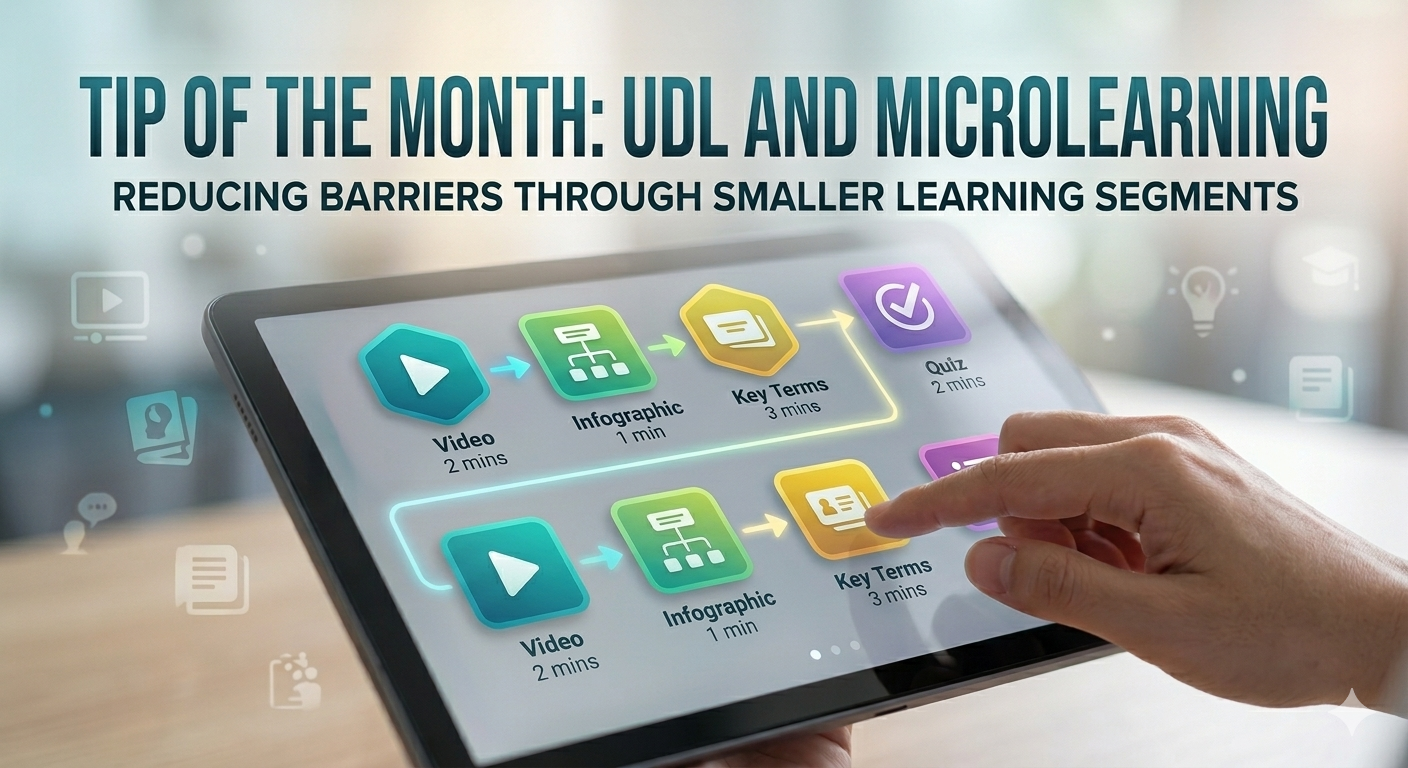
Short, focused microlearning segments can significantly improve engagement and retention when designed intentionally. When viewed through a UDL lens, microlearning is more than shorter videos or chunking content; it’s about reducing cognitive load, increasing flexibility, and offering multiple ways for learners to access and engage with content.
Reducing Barriers through Segmented Content
For effective microlearning, consider breaking content into 5- to 10-minute segments, each tied to a single concept and paired with a brief activity. Research on multimedia learning and Mayer’s “segmenting principle,” suggest that learners process information more effectively when it is segmented and focused, rather than presented in long, continuous streams (Mayer, 2021). From a UDL perspective, this principle supports perception and comprehension (CAST, 2024c) by helping learners manage cognitive load and revisit key ideas as needed (CAST, 2024b).
Aligning Objectives with Action and Expression
Effective microlearning also requires tight alignment and strategic application. For optimal effectiveness, each segment should connect to a learning objective and include an opportunity to apply or check understanding. This is where microlearning can support multiple means of Action & Expression. Learners aren’t just consuming content but actively using it and building on it in multiple low-stakes ways (CAST, 2024a). Without alignment and application, microlearning can become fragmented and less effective.
Building Momentum Toward Broader Goals
Microlearning and application can be bundled into modules or units that allow learners to see individual pieces and how they connect to broader goals. This design approach aligns with the “executive functions” of the UDL framework’s strategic network by helping learners understand, plan, and monitor progress (CAST, 2024d). Following are some discipline-specific examples of how microlearning activities can be structured and sequenced to achieve broader learning outcomes or skills.
UDL-focused Microlearning Sequence Examples
Biochemistry (Metabolic Pathways)
Microlearning Strategies: This sequence moves from visualizing a complex system to identifying its parts, and finally to analyzing how those parts interact. By mastering the building blocks first (Mayer, 2021), students are better prepared to tackle the "big picture" logic of the system.
- Segment 1: Overview video + labeled diagram
- Segment 2: Interactive labeling of pathway steps
- Segment 3: Prediction question on regulation points
Political Science (Case-Based Learning)
Microlearning Strategies: Encourages relevance and transfer (Ambrose et al., 2010). This learning progression moves from the acquisition of a foundational concept (federalism) to its contextualization through a real-world example (short case study), culminating in an active application task (2- to 3-question application prompt) that facilitates the transfer of knowledge to new and diverse scenarios.
- Micro-lesson on a foundational concept (e.g., federalism)
- Short case example (contextualization)
- 2–3 question application prompt
Composition (Writing Skills)
Microlearning Strategies: Just-in-time support aligned with assignment needs. This progression shifts from understanding a writing rule to practicing it in a low-stakes way, before applying that knowledge to help a peer.
- Thesis development mini-lesson + rewrite task
- Source integration example + quick practice
- Citation check activity
Engineering (Problem Solving)
Microlearning Strategies: Reinforces mastery through incremental steps. This sequence guides students from observing an expert’s process, to deconstructing the steps in an example, and finally to independent execution.
- Concept explanation: 5-minute breakdown of the forces in a free body diagram
- Worked example: step-by-step how to calculate support
- Short practice with immediate feedback
Nursing (Clinical Skills)
Microlearning Strategies: Supports self-regulation and applied learning. This progression moves from modeling a professional standard to internalizing the steps through a checklist.
- Short demonstration video
- Skills checklist
- Scenario-based self-assessment
Common Microlearning Pitfalls (and How to Fix Them)
Pitfall 1: Chunking Without Purpose
Breaking content into smaller pieces without clear objectives can lead to fragmentation.
Fix: Ensure each segment has a single learning goal + aligned activity (Mayer, 2021).
Pitfall 2: Overloading with Too Many Micro-Options
Too many videos, tools, or choices can overwhelm learners.
Fix: Curate 2–3 high-value resources per concept and clearly label what is essential vs. optional
Pitfall 3: Loss of Big-Picture Coherence
Learners may struggle to see how pieces fit together.
Fix: Use module overviews, concept maps, or weekly summaries to help learners connect segments
Pitfall 4: Passive Consumption
Short videos alone do not improve learning.
Fix: Pair each segment with an active element that involves retrieval, application, or reflection.
Pitfall 5: Assuming Microlearning Works Everywhere
Not all content benefits from microlearning.
Fix: Use microlearning selectively (see below).
When Microlearning May Not Be the Best Approach
Microlearning is powerful but not universal. It may not be the best approach for:
- Deep discussions or storytelling-based lectures can benefit from longer formats where ideas build over time.
- Capstone-level integration may require fewer, longer sessions rather than many small ones.
- Complex synthesis tasks often require extended, uninterrupted engagement.
The Bottom Line
Ultimately, shifting toward microlearning is about building a kind of cognitive momentum. By breaking complex threshold concepts into modular, intentionally sequenced units that scaffold more sophisticated synthesis, we can help learners stay in the "flow" of the learning experience rather than getting overwhelmed by the sheer volume of a single sitting.
This structured approach also allows learners to master the essential building blocks of a field before being asked to apply them to those broader, integrative skills we ultimately value. If you’ve read this far, why not try taking just one "heavy lift" topic in your course and deconstructing it into a few purposeful, linked segments. You might just find that providing that extra bit of breathing room makes the climb toward those big, complex learning goals feel more attainable for everyone!
References
- Ambrose, S. A., Bridges, M. W., DiPietro, M., Lovett, M. C., & Norman, M. K. (2010). How learning works: Seven research-based principles for smart teaching. Jossey-Bass.
- CAST. (2024a). Build fluencies with graduated support for practice and performance. Universal Design for Learning Guidelines version 3.0.
- CAST. (2024b). Cultivate multiple ways of knowing and making meaning. Universal Design for Learning Guidelines version 3.0.
- CAST. (2024c). Design options for perception. Universal Design for Learning Guidelines version 3.0.
- CAST. (2024d). Enhance capacity for monitoring progress. Universal Design for Learning Guidelines version 3.0.
- Mayer, R. E. (2021). Multimedia learning (3rd ed.). Cambridge University Press.
Beyond the Problem Set: Enabling Multiple Means of Expression Across the STEM Curriculum
By Marc Thompson
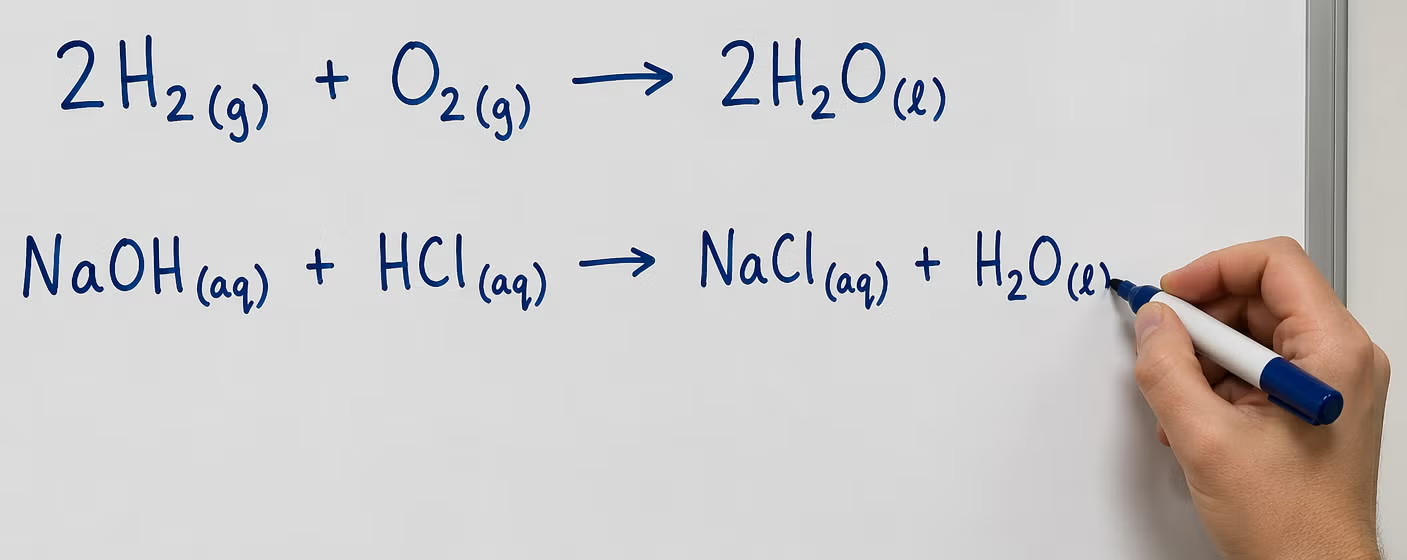
In courses like Math, Physics, and Chemistry, the “problem set” is a familiar and often foundational way to assess student learning. STEM courses like these often rely on symbolic representation and abstract reasoning to solve practical, real-world problems. At the same time, when we require students to submit their work in a single format, like handwritten solutions, LaTeX-heavy PDFs, or proprietary software files, we may end up measuring more than we intended to. In some cases, we’re not just assessing conceptual understanding but auxiliary demands like formatting fluency, transcription accuracy, or even fine motor skills (in manual graphing, for instance). When the method of expression gets intertwined with what we are assessing, it’s worth taking a closer look at whether those additional demands are actually part of the learning goal and whether providing students with greater choice in how they demonstrate their knowledge might lead to a more accurate picture of their mastery (Thompson, 2024).
Construct Relevance: Focusing on the Science
One way to design choices strategically is through the lens of construct relevance (Ambrose et al., 2010). In any assessment, the construct is the specific knowledge or skill you want to measure. In this context, the barrier is an extra demand that isn’t essential to that goal, such as the requirement to manually transcribe a complex 3D molecular structure into a 2D drawing or SMILES format (a text-based notation for representing molecules) when the primary goal is simply to identify functional groups.
This is where the UDL principle of Multiple Means of Action and Expression can be especially helpful (CAST, 2024). By providing multiple ways for students to express their thinking, we can hold the learning outcome constant while loosening the constraints on how that knowledge is demonstrated. Even small, plus-one adjustments to familiar tasks can make it easier to see what students actually understand. We can definitely reduce barriers this way, and we can do so without lowering expectations or academic rigor (Meyer, Rose, & Gordon, 2014).
For a taste of what this specific application of UDL might look like in practice, the following examples show how small, intentional adjustments can expand opportunities for students to demonstrate learning without changing the core outcomes being assessed or obscuring the construct by introducing extra demands that aren't part of the key learning outcome(s).
A Few Plus-One Examples for STEM
Molecular and Cellular Biology: Signal Transduction Pathways
- Default Submission: Produce a labeled diagram of a signaling pathway with a written explanation describing each phosphorylation step and downstream effect.
- Option A (Creative Synthesis Task): Create an interactive storyboard or “choose your own adventure” pathway (using tools like Google Slides or Twine, a tool for telling interactive, non-linear stories) where the user acts as a ligand binding to a receptor. Each “decision point” must correctly represent pathway branching, amplification, or inhibition.
- Option B (Narrative Case Task): Record a 3–5 minute podcast or “medical news report” explaining what happens when a specific mutation disrupts the pathway (e.g., constitutive activation of Ras in cancer), including upstream cause and downstream effects.
- Learning Outcome: Explain signal amplification, pathway regulation, and cellular response mechanisms.
Biochemistry: Nitrogen Cycling in Aquatic Systems
- Default Submission: Complete a worksheet calculating nitrogen species concentrations (NH₄⁺, NO₃⁻) and fluxes in a modeled lake system.
- Option A (Modeling Task): Build a simple box model in Excel or Google Sheets showing nitrogen inputs (e.g., fertilizer runoff) and outputs over time. Include at least one manipulated variable (e.g., increased agricultural input) and a brief interpretation of system response (e.g., eutrophication trends).
- Option B (Applied Analysis Task): Review a short, intentionally flawed environmental impact report for a watershed. Annotate the document to identify incorrect chemical assumptions (e.g., misrepresented nitrification rates) and propose a corrected remediation strategy.
- Learning Outcome: Apply nitrogen cycle principles to analyze and predict changes in aquatic systems.
Physics: Work–Energy Theorem
- Default Submission: Complete a set of textbook problems calculating work, force, and velocity using given parameters.
- Option A (Application Task): Solve a scenario involving a 50 kg crate pushed up a 20° incline with friction (coefficient provided), showing all steps and interpreting the physical meaning of the result (e.g., energy lost to friction).
- Option B (Experimental Analysis Task): Record a short video of an object (e.g., a ball rolling down a ramp). Using frame-by-frame analysis (or estimation), calculate final velocity and use energy conservation to estimate the ramp height. Include assumptions and sources of error.
- Learning Outcome: Relate work, force, displacement, and kinetic energy in physical systems.
Chemistry: Reaction Mechanisms
- Default Submission: Produce a static, hand-drawn or digitally rendered mechanism showing the SN1 and SH2 electron flow with curved arrows.
- Option A (Process-Oriented Explanation): Record a screen capture while drawing the mechanism step-by-step, narrating electron movement, intermediate stability, and why each step occurs.
- Option B (Error Analysis Task): Given an incorrect or incomplete reaction mechanism, annotate the errors (e.g., incorrect arrow direction, missing intermediate) and submit a corrected version with a brief written justification for each revision.
- Learning Outcome: Explain mechanistic reasoning, including electron flow and intermediate formation.
Mathematics: Convergence of Infinite Series
- Default Submission: Complete a 15-problem set calculating convergence using various tests (Ratio, Root, Integral).
- Option A (Procedural Application): Solve a targeted set of 5 - 7 problems, accompanied by a brief "test selection" justification for each, explaining which structural features of the series (like factorials or exponents) led to the choice of a specific test.
- Option B (Structural Synthesis Task): Create a decision tree or flowchart that guides someone through selecting an appropriate convergence test based on the structure of a given series (e.g., factorials, exponentials, alternating terms).
- Learning Outcome: Demonstrate understanding of when and why specific convergence tests apply.
Disciplinary Fluency and Foundational Understanding
Of course, skills like LaTeX markup, vector notation, or IUPAC nomenclature are genuinely important. The question is when they should count. If the goal is to gain experience using professional disciplinary standards, then those skills are part of the construct. But if the goal is to model a phenomenon or justify a step in a process, then the format used to communicate that solution becomes secondary.
In this context, offering multiple means of expression actually sharpens rigor by reducing construct-irrelevant demands and allowing students to focus more tightly on key learning tasks. This also clarifies the evidence of learning, allowing instructors to more accurately evaluate mastery of the core objectives, whether it’s applying a concept, analyzing a system, or constructing a valid argument. As students move into more advanced work, field-specific technical standards can be brought in more explicitly as part of the assessment.
Digital Tools as an Equalizer
Digital STEM tools like EquatIO and Desmos allow students to express mathematical thinking without getting too bogged down in formatting details and mechanics. These tools also help students build inclusive skills. EquatIO can produce equations in MathML, the gold standard for accessible math, while the Desmos graphing calculator provides audio trace sonification (turning graphs into sound) that lets blind or low-vision users “hear” the geometry of the data, like the periodicity of a sine wave or the symmetry of a parabola.
Closing the Loop
When students have options for action and expression, it becomes easier to see what they actually know and less likely that unrelated barriers will get in the way. In STEM, where abstraction and precision already demand a lot from students, small “plus-one” changes like adding carefully chosen deliverable format options or multiple assignment choices can make a significant difference. In the end, the goal isn’t so much changing what students learn but ensuring that how they show it truly reflects their mastery of the science.
References
- Ambrose, S. A., Bridges, M. W., DiPietro, M., Lovett, M. C., & Norman, M. K. (2010). How learning works: Seven research-based principles for smart teaching. Jossey-Bass.
- CAST. (2024). Universal Design for Learning Guidelines version 3.0.
- Meyer, A., Rose, D. H., & Gordon, D. (2014). Universal design for learning: Theory and practice. CAST Professional Publishing.
- Thompson, Marc. (2024, November). "Clear Goals, Multiple Means".
Centering the "Who" of Learning: An Introduction to UDL Guidelines 3.0
By Marc Thompson

Since it first took root in higher education, Universal Design for Learning (UDL) has given us a great roadmap for handling student variability. Grounded in neuroscience, the original framework mapped course design to three core cognitive networks: the "Why" of learning (Engagement), the "What" of learning (Representation), and the "How" of learning (Action & Expression) (Meyer et al., 2024; Thompson, 2023a, 2023b, and 2024a). For years, these pillars helped us build flexible choices into our courses, like offering text alongside audio or varying how students demonstrate mastery. Now, after years of mastering the why, what, and how, the UDL 3.0 update finally brings it all home by explicitly centering the “Who" of learning (CAST, 2024).
The Learner as Active Co-Designer
The core idea behind UDL 3.0 is that learning doesn't happen in a vacuum. A student's cultural background, native language, identity, and lived experiences directly shape how they take in, process, and connect with new information (Waitoller & Thorius, 2016). By putting the "Who" front and center, the updated UDL framework takes a more personal and individualistic view of learning. It reminds us that our students are whole people, and that traditional course layouts can sometimes hold hidden, systemic biases that create unfair barriers to success (Rao et al., 2023).
In centering the "Who," the role of the learner becomes much more active. The framework also shifts from more of a top-down model where the instructor "provides options" to a more collaborative approach where we "design options" alongside our students (Gravel & Novak, 2024). This changes the ultimate goal of UDL. It moves us beyond cultivating "expert learners" (Thompson, 2024b) who know how to navigate a pre-built course, and pushes us toward fostering true learner agency where all students, including marginalized learners, are trusted to co-create their own educational journeys (Restani, 2021).
Mapping the Evolution: Key Terminology and Structural Updates
To understand how centering the "Who" impacts our day-to-day teaching, let's take a closer look at the some of the ways the UDL guidelines have been reframed in the 3.0 update to elevate student identity, language, and emotional capacity (CAST, 2024).
Multiple Means of Engagement: Welcoming Identities & Emotional Capacity
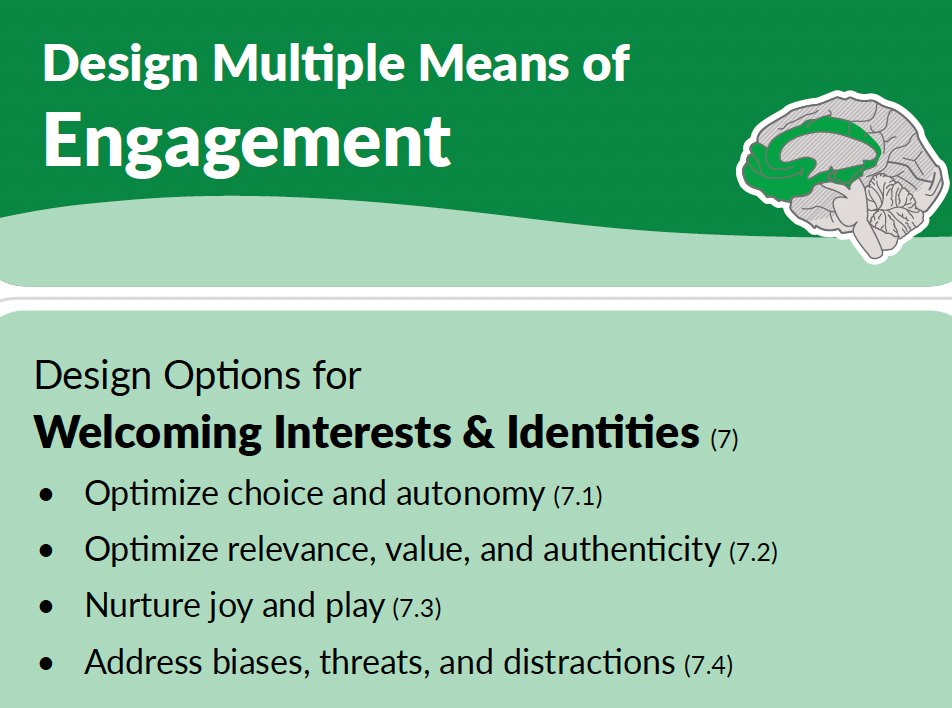
- Reframed from "Recruiting Interest" to "Welcoming Interests and Identities": While early frameworks focused on initial engagement, this update expands that scope by prompting us to design learning environments where a student's full cultural identity and unique background are welcomed as real intellectual assets to our discussions from day one (see Figure 1). In Practice: In a Business Administration or Marketing class, instead of analyzing a generic, pre-selected corporate case study, the instructor invites students to pitch a local business, community organization, or cultural enterprise from their own neighborhood to analyze for their core project.
- From "Self-Regulation" to "Emotional Capacity": Grounded in the reality of student stress and academic anxiety, this shift recognizes that emotional well-being is completely tied to learning. Design strategies focus on building peer teamwork, normalizing mistakes as a natural part of the learning process, and pacing workloads to keep students focused and motivated.
In Practice: In an introductory STEM or calculus course notorious for high "math anxiety," the instructor builds in low-stakes, collaborative problem-solving sessions where mistakes are explicitly analyzed as valuable data points rather than penalized on a grading sheet.
Multiple Means of Representation: Building Knowledge Together
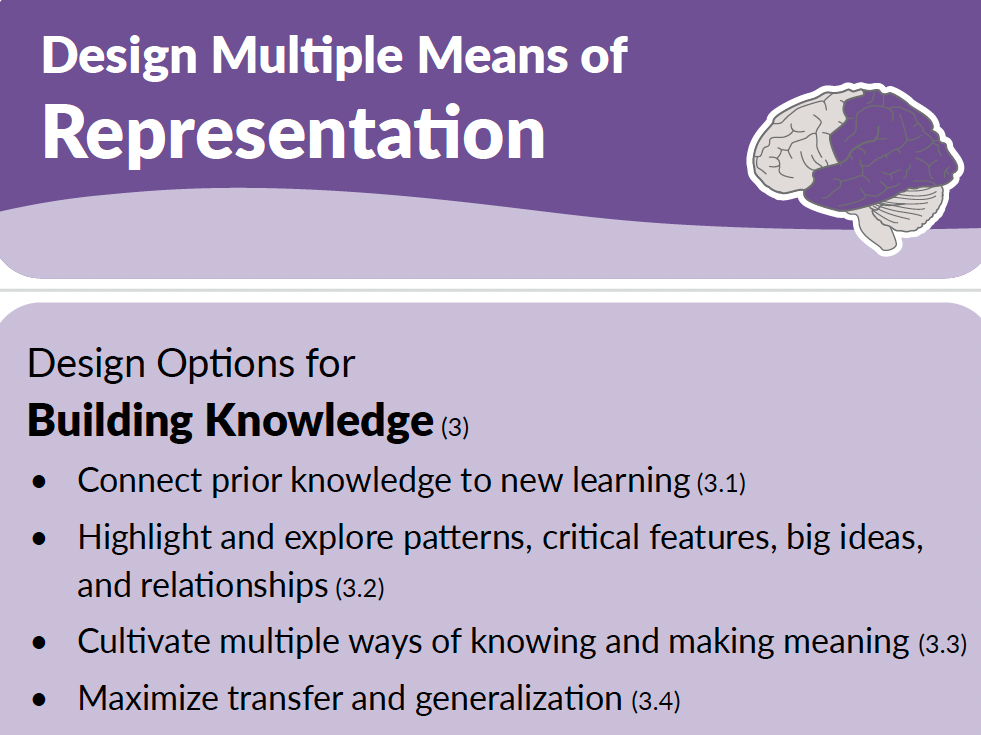
- From "Comprehension" to "Building Knowledge": This evolution goes beyond basic formatting choices like text versus video. It encourages us to take a close look at *whose* voices, histories, and perspectives are featured in our readings, ensuring diverse cultural and disciplinary frameworks are integrated throughout the course rather than isolated in a single week (see Figure 2).
In Practice: In a Community Health or Public Policy syllabus, foundational frameworks are presented alongside grassroots, community-led health initiatives and localized case studies written by historically underrepresented researchers in the field. - Linguistic Respect: The guidelines explicitly emphasize cultivating respect for diverse languages and dialects. This prompts us to ask whether rigid communication norms are truly necessary for a specific learning outcome, or if they are acting as artificial barriers to students showing what they know (Thompson, 2026).
In Practice: During early brainstorming or peer-review stages in a Creative Writing or Composition workshop, the instructor allows students to map out concepts, outlines, or narrative arcs in their native language, regional dialect, or code-switched vernacular.
Moving Forward: The "Plus-One" Strategy
Putting UDL 3.0 into practice doesn't mean throwing out your current syllabus or lowering your course standards. It's about making sure every student has a clear path to truly mastering the content. The new framework invites us to apply a practical "plus-one" approach to our designs: keeping our learner supports and digital accessibility intact, while actively looking at our course policies, reading lists, and assignments through the lens of the "Who." By treating student variability and identity as strengths rather than logistical hurdles, we can build a course layout where all students are recognized, supported, and empowered to actively shape their own learning paths.
Looking Ahead: UDL 3.0 Miniseries
Because centering the "Who" is such an important addition to the UDL framework, this introduction is just the kickoff. Over the coming months, our UDL Tip of the Month series will dive more deeply into the specific features of version 3.0, offering practical tips on how these updates impact our teaching and course design practices. Here's a peek at our upcoming articles:
- Beyond Access to Belonging: Unpacking the New Inclusivity Focus in UDL Guidelines 3.0
- Moving Past "Preferences": The Science of Dynamic Learner Variability
- The Affective Network Deep Dive: Designing Course Narratives that Spark Purpose
- Whose Voice is It? Elevating Student Co-Design in Course Material Selection
- Culturally Responsive UDL: Validating Learner Identities and Lived Experiences
- Hidden in Plain Sight: Identifying and Rooting Out Systemic Biases in Higher Ed Assessments
References
- CAST. (2024). Universal Design for Learning Guidelines version 3.0 [PDF Graphic Organizer]. https://udlguidelines.cast.org/static/udlg3-graphicorganizer-digital-numbers-a11y.pdf
- Gravel, J. W., & Novak, K. (2024). UDL Guidelines 3.0: A community-driven, research-based process toward fulfilling the promise of Universal Design for Learning. International Journal of Universal Design for Learning. https://journals.imist.ma/index.php/IJUDUDL/article/view/6592/5809
- Meyer, A., Rose, D. H., & Gordon, D. (2024). Universal design for learning: Theory and practice. CAST Professional Publishing. https://www.cast.org/books-media/udl-principles-framework-practice/
- Rao, K., Gravel, J. W., Rose, D. H., & Tucker-Smith, N. (2023). Universal Design for Learning in its 3rd decade: A focus on equity, inclusion, and design. Journal of Inclusive Education Design, 11(1), 45-58. https://www.researchgate.net/publication/365593948_Universal_Design_for_Learning_in_its_3rd_decade_a_focus_on_equity_inclusion_and_design
- Restani, R. (2021). Practitioner research: Reflecting on minoritized student agency in a reform-based secondary mathematics classroom. The Journal of Mathematical Behavior, 62, Article 100856. https://mted.merga.net.au/index.php/mted/article/view/553.
- Thompson, M. (2023a, November). UDL Principle 1: Multiple Means of Engagement. Center for Innovation in Teaching & Learning, University of Illinois Urbana-Champaign. https://citl.illinois.edu/udl-tip-month-2023.
- Thompson, M. (2023b, December). UDL Principle 2: Multiple Means of Representation. Center for Innovation in Teaching & Learning, University of Illinois Urbana-Champaign. https://citl.illinois.edu/udl-tip-month-2023.
- Thompson, M. (2024a, January). UDL Principle 3: Multiple Means of Action and Engagement. Center for Innovation in Teaching & Learning, University of Illinois Urbana-Champaign. https://citl.illinois.edu/udl-tip-month-2024.
Thompson, M. (2024b, March). Fostering Expert Learners. Center for Innovation in Teaching & Learning, University of Illinois Urbana-Champaign. https://citl.illinois.edu/udl-tip-month-2024.
Thompson, M. (2026, January). Cutting Through the Noise to Build Better Choice Rubrics. Center for Innovation in Teaching & Learning, University of Illinois Urbana-Champaign. https://citl.illinois.edu/udl-tip-month-2026.
- Waitoller, F. R., & Thorius, K. A. K. (2016). Cross-pollinating culturally sustaining pedagogy and universal design for learning: Toward an inclusive pedagogy that accounts for dis/ability (PDF). Harvard Educational Review, 86(3), 366-389. https://edspace.american.edu/culturallysustainingclassrooms/wp-content/uploads/sites/1030/2017/09/culturally_sustaining_pedagogy_andUDL.pdf
Longing for Belonging: Unpacking the New Inclusivity Focus in UDL Guidelines 3.0
By Marc Thompson

In the first article of this series, we looked at how the 2024 Universal Design for Learning (UDL) Guidelines 3.0 update puts the "Who" of learning squarely at the center of course design (CAST, 2024; Thompson, 2026a). In this student-centered context, foundational accessibility practices can dramatically reduce barriers for learners. The UDL 3.0 update expands this essential groundwork by introducing relational design strategies focused on human connections, psychological safety, and identity validation (Gravel & Novak, 2024). Taken together, these conditions help foster a learning environment of belonging that invites students to engage more deeply, take intellectual risks, and achieve deeper learning. So, how can we intentionally design for this kind of belonging in our own courses?
Fostering belonging begins with asking fundamental questions about the student experience: When learners engage with your course, are they able to draw upon their backgrounds and lived experiences as learning strategies? (Waitoller & Thorius, 2016). Does the learning environment actively validate their identities, reduce unnecessary friction, and build community? (Rao et al., 2023) When course design intentionally addresses these kinds of questions, it can significantly reduce student anxiety and promote new pathways for learning. Let's see how this might unfold in practice.
Designing for Belonging Across the Three UDL Pillars
To see what designing for belonging looks like in practice, let's explore how UDL 3.0 incorporates belonging into each core pillar of the framework (CAST, 2024).
Multiple Means of Engagement: Cultivating Psychological Safety & Community
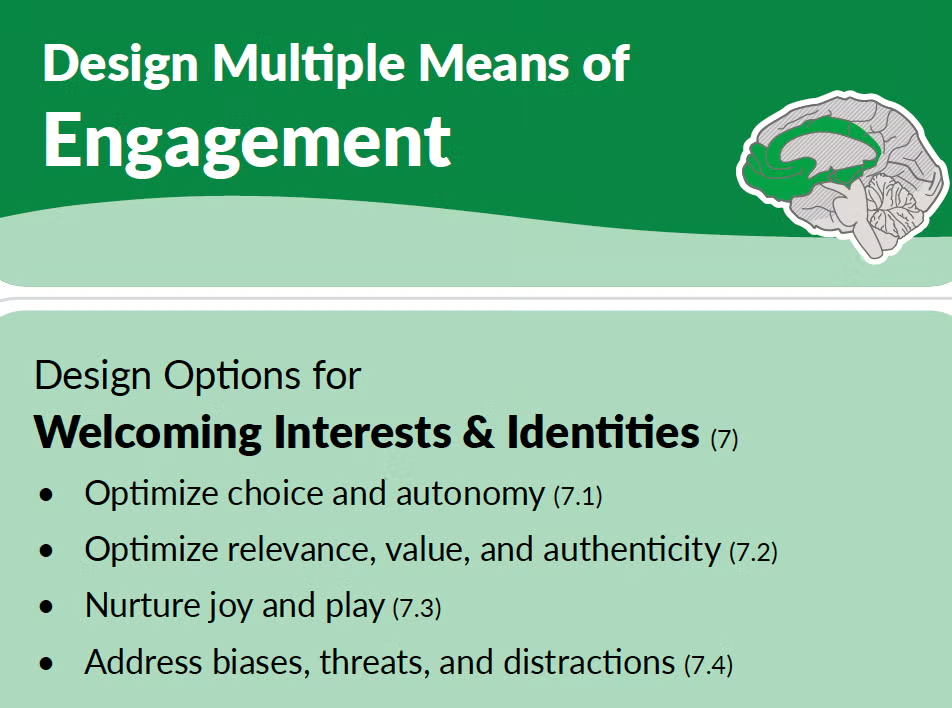
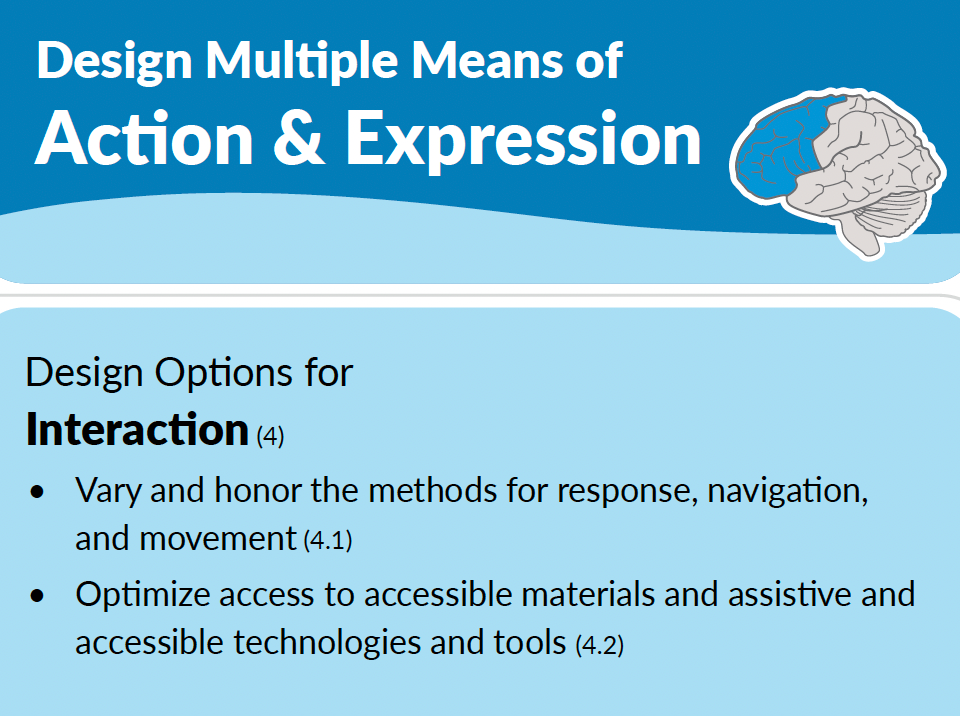
Belonging starts with psychological safety. UDL 3.0 encourages us to design spaces where students feel safe taking academic risks without worrying about being judged or feeling excluded. This is reflected in the UDL guideline for "Design[ing] Options for Welcoming Interests & Identities" (see Figure 1). One design strategy for accomplishing this is using structured group work to build real connection and community (Consideration 7.3 & Consideration 8.3 .
Here are a few cross-disciplinary examples:
- Sociology / Political Science (Co-Created Discussion Norms): During the first week, students work together in a Canvas discussion thread to draft ground rules for debating controversial policy topics, such as universal basic income or urban gentrification. In this example the structured group work of co-creating guidelines for respectful critique and active listening can help create a safer foundation for tough, highly polarized, or emotionally charged online debate topics later in the term.
- Engineering Design Lab (Structured Cooperative Role Rotations): Group assignments require students to rotate specific team roles (such as project manager, technical lead, data analyst, and spokesperson) across each lab module. Standardizing these roles ensures that no single student inadvertently monopolizes hands-on technical tasks, guaranteeing that peers who enter without prior coding or fabrication experience aren't automatically relegated to administrative duties like note-taking, giving everyone equal hands-on time with advanced tools.
- Organic Chemistry (Collaborative Problem-Solving Groups): Students tackle complex reaction mechanisms in small study groups during active-learning sessions. To remove the stigma of making mistakes, the instructor presents hypothetical or past errors as diagnostic team exercises rather than calling out individual students.
- Computer Science / Team Software Projects (Coordinated Peer Review): Team coding assignments include clear guidelines and rubrics for reviewing each other's code, focusing on readability and collaborative troubleshooting. This kind of structured group setting can help build shared ownership of the project while also allowing self-taught or non-traditional coders to gain constructive, actionable feedback without feeling daunted by peers with more extensive coding experience.
Multiple Means of Representation: Mirroring Diversity in Course Content
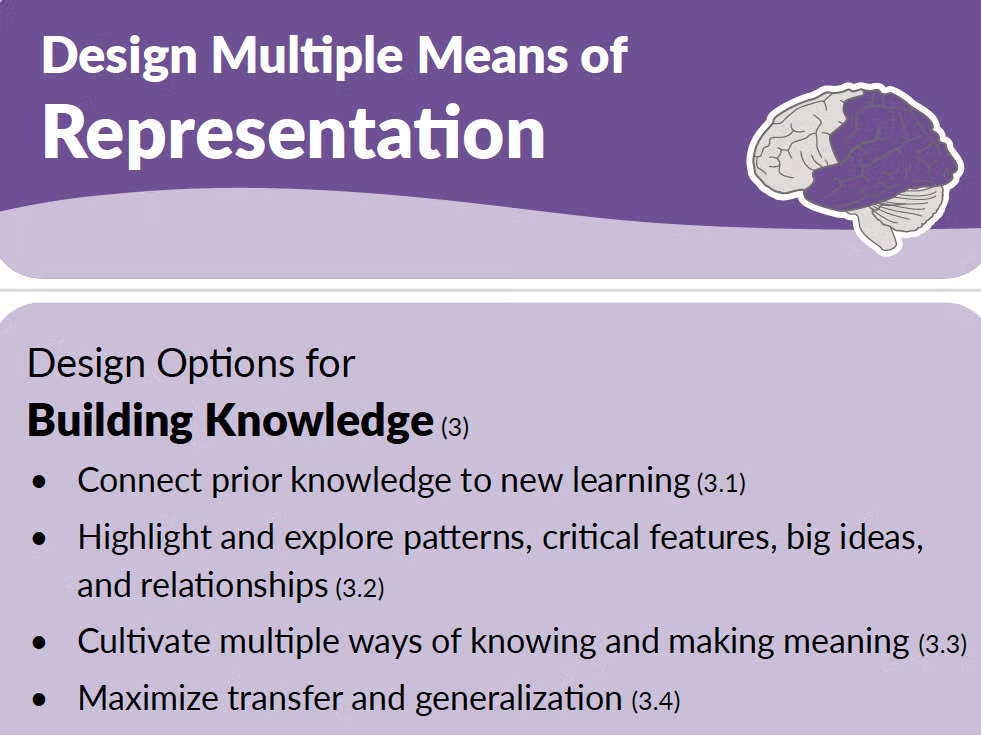
Research shows that when students see their identities reflected in their fields (what researchers call "cultural relevance") their motivation, conceptual understanding, and performance improve (Gay, 2018; Ladson-Billings, 2021). This is illustrated in part by the UDL guideline for "Design[ing] Options for Building Knowledge" (see Figure 2), as well as "Options for Language and Symbols" that include "cultivat[ing] understanding and respect across languages and dialects" and "illustrat[ing] through multiple media." In short, expanding representations by diversifying standard instructional materials can help students make sense of abstract concepts by grounding them in more familiar, relatable real-world contexts and diverse cultural frameworks (Consideration 3.3 & Consideration 2.1).
Here are a few cross-disciplinary examples:
- Environmental Science (Multiple Ways of Knowing): When studying climate adaptation (e.g., strategies for managing regional heat stress and wildfire risks), the instructor pairs peer-reviewed predictive climate models (like NOAA regional temperature projections) alongside Indigenous ecological science, like controlled cultural burning techniques used by western tribal nations to prevent catastrophic wildfires. Side-by-side, these models help students understand how modern predictive data and long-standing ancestral land management complement one another to form a more comprehensive regional climate strategy.
- Economics (Authentic Case Representation): An Economics professor audits exam word problems and case studies to ensure diverse names, global contexts, and varied socioeconomic settings are represented, replacing some of the corporate scenarios with community-oriented economic challenges.
- Introductory Psychology (Diversifying Scientific Canon): When covering cognitive and developmental psychology, the course includes foundational studies from global, female, and minority researchers alongside canonical Western experiments, giving students a broader view of how psychological science developed.
- Environmental Literature (Pluralistic Worldviews): The reading list is updated beyond traditional Western wilderness texts to feature multimodal works from urban, global, and marginalized authors, expanding the concept of "nature" to include topics like urban ecology and environmental justice.
- Business Management (Counter-Narratives in Leadership): A corporate strategy module includes case studies on non-traditional business models alongside standard Fortune 500 examples to explore alternate leadership structures. For instance, students examine community worker cooperatives like the Mondragon Corporation to see shared governance in action. They also analyze rural microfinance initiatives like Muhammad Yunus's Grameen Bank to understand how microcredit models drive sustainable economic growth outside traditional corporate frameworks.
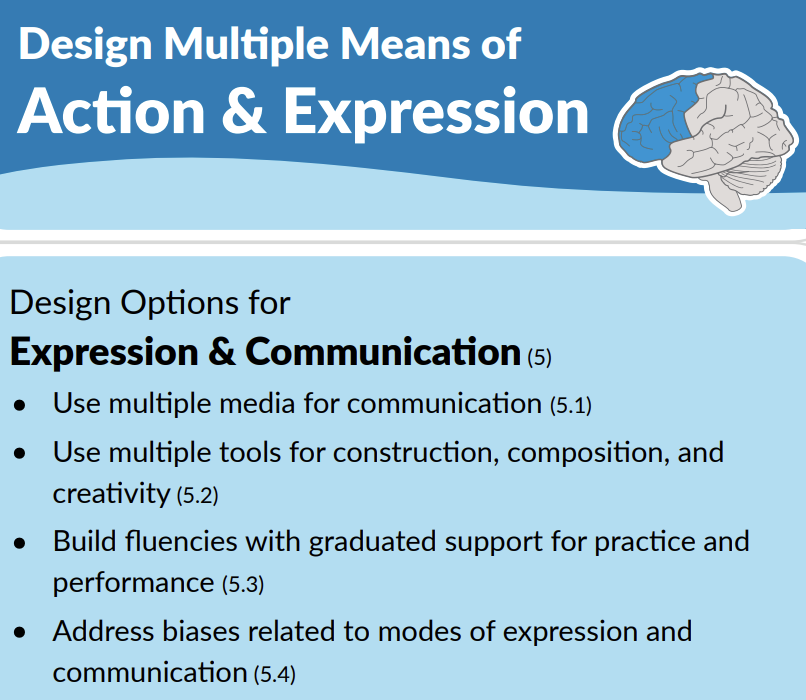
Plus-One Challenge: Putting Belonging into Practice
Now that we've looked at several cross-disciplinary examples of how we can design for belonging, it's your turn to take the plus-one challenge!
Try picking one of the following UDL design changes to implement this semester:
1. Audit Your Reading List
Find one module where you can introduce a foundational reading or case study authored by a researcher from a historically underrepresented group.
Example
In a Business or Economics course, include case studies on microfinance and social entrepreneurship co-authored by global scholars, such as research on the Grameen Bank model.
2. Reframe Your Welcome Message
Check the tone of your syllabus and introductory announcements to make sure they explicitly communicate that diverse perspectives are welcomed assets.
Sample Wording
"Diversity of background, identity, and perspective is a vital strength of this class. Whether you are returning to school, balancing family responsibilities, are a first-generation college student, or bring diverse cultural traditions, your lived experiences bring value to our work together. If any aspect of this course creates a barrier to your learning or sense of inclusion, please let me know so we can adjust."
3. Add an Authentic Choice
Give students an opportunity to connect course concepts to their local communities or cultural experiences. If your course is abstract (e.g., introductory calculus or organic chemistry), offer choice through contextual application instead by letting students choose which real-world field they apply formulas to in problem sets.
Sample Contextual Options
An assignment on calculating rates of change might offer students a choice of multiple real-world contexts like calculating drug absorption and decay rates in the bloodstream over time (Pharmacology), modeling the rate of runoff and pollutant dispersion in a local watershed (Environmental Science), and analyzing velocity and acceleration data from an athlete's sprint performance (Kinesiology/Sports Medicine).
4. Redesign an Assessment Criteria Prompt
Re-evaluate a rubric or project prompt to explicitly value diverse ways of knowing, communicating, or presenting evidence. Rather than penalizing non-traditional forms of expression by default, offer students a pathway to integrate community wisdom or lived experience alongside traditional scholarly sources.
Sample Prompt Option
"In addition to four peer-reviewed academic sources, you may cite one 'community source,' such as an oral history interview with a local community organizer, a transcript from a public town hall, or a cultural narrative. Your analysis should critically evaluate how the lived experiences shared in your community source confirm, challenge, or extend the theoretical frameworks found in your academic literature."
5. Normalize Help-Seeking & Office Hours
Reframe office hours from an intimidating, corrective space into an inviting, collaborative routine. First-generation students or those from underrepresented backgrounds sometimes view office hours as a place you only go when you are failing or in trouble.
Sample Wording
"You don't need to have a broken equation or a draft paper to drop in! During Weeks 2 and 3, I'm holding 10-minute 'Coffee & Strategy Chat' slots. Stop by to talk about how your study strategies are going, how course concepts are connecting to your career goals, or just grab a cup of tea. If these times overlap with your work or caregiving schedule, send me an email and we'll set up an alternate time."
6. Build a Collaborative "Glossary of Lived Knowledge"
Create a low-stakes, ongoing opportunity for students to bring their own cultural, professional, or linguistic expertise into the working terminology of the course. Abstract concepts become clearer when students see their own experiences reflected in the definitions.
Sample Activity
In an Introductory Psychology, Communications, or Management course, set up an editable class Wiki or shared slide deck where students contribute a real-world application of a key term. Prompt: "For Module 4, pick one core concept (e.g., 'Cognitive Dissonance,' 'Code-Switching,' or 'Psychological Safety') and add a slide to our Class Glossary. Illustrate the concept using an example from your workplace, a cultural practice, a bilingual idiom, or a community dynamic you've experienced firsthand."
All Together Now!
Taking small, intentional steps like these plus-one UDL strategies can help cultivate an environment of belonging. Across all three UDL 3.0 pillars, intentional design choices around belonging transform the learning experience of the course: Engagement builds the psychological safety and community needed for intellectual risk-taking; Representation mirrors diverse voices so students see themselves in the discipline; and Action & Expression validates authentic ways for students to demonstrate mastery. When we bring these perspectives together, we cultivate a learning community where every student is recognized, supported, and empowered to succeed.
Up Next: "The Science of Dynamic Learner Variability"
In our next UDL Tip of the Month installment, "Moving Past 'Preferences': The Science of Dynamic Learner Variability," we'll examine how UDL 3.0 updates the framework's core cognitive science. We'll contrast earlier UDL models (which often treated learner variability as a set of internal individual traits) with 3.0's emphasis on contextual variability, exploring how working memory, executive function, and focus fluctuate dynamically based on environment, stress, and instructional design.
References
- CAST. (2024). Universal Design for Learning Guidelines version 3.0 [Graphic Organizer]. https://udlguidelines.cast.org/static/udlg3-graphicorganizer-digital-numbers-a11y.pdf
- Gay, G. (2018). Culturally responsive teaching: Theory, research, and practice (3rd ed.). Teachers College Press.
- Gravel, J. W., & Novak, K. (2024). UDL Guidelines 3.0: A community-driven, research-based process toward fulfilling the promise of Universal Design for Learning. International Journal of Universal Design for Learning. https://journals.imist.ma/index.php/IJUDUDL/article/view/6592/5809
- Ladson-Billings, G. (2021). Culturally relevant pedagogy: Asking a different question. Teachers College Press.
- Rao, K., Gravel, J. W., Rose, D. H., & Tucker-Smith, N. (2023). Universal Design for Learning in its 3rd decade: A focus on equity, inclusion, and design. Journal of Inclusive Education Design, 11(1), 45-58. https://www.researchgate.net/publication/365593948_Universal_Design_for_Learning_in_its_3rd_decade_a_focus_on_equity_inclusion_and_design
- Steele, C. M., & Aronson, J. (1995). Stereotype threat and the intellectual test performance of African Americans. Journal of Personality and Social Psychology, 69(5), 797–811. https://www.researchgate.net/publication/15726133_Stereotype_Threat_and_the_Intellectual_Test_Performance_of_African_Americans
- Thompson, M. (2026a, February). Centering the "Who" of Learning: An Introduction to UDL Guidelines 3.0. Center for Innovation in Teaching & Learning, University of Illinois Urbana-Champaign. https://citl.illinois.edu/udl-tip-month-2026
- Thompson, M. (2026b, January). Cutting Through the Noise to Build Better Choice Rubrics. Center for Innovation in Teaching & Learning, University of Illinois Urbana-Champaign. https://citl.illinois.edu/udl-tip-month-2026
- Waitoller, F. R., & Thorius, K. A. K. (2016). Cross-pollinating culturally sustaining pedagogy and universal design for learning: Toward an inclusive pedagogy that accounts for dis/ability. Harvard Educational Review, 86(3), 366-389. https://edspace.american.edu/culturallysustainingclassrooms/wp-content/uploads/sites/1030/2017/09/culturally_sustaining_pedagogy_andUDL.pdf
- Winkelmes, M. A., Bernacki, M., Butler, J., Zochowski, M., Golanics, J., & Harriss, K. H. (2016). A teaching intervention that increases underserved college students' success. Peer Review, 18(1/2), 31-36.
https://www.researchgate.net/publication/309351208_A_Teaching_Intervention_that_Increases_Underserved_College_Students'_Success
Moving Past "Preferences": The Science of Dynamic Learner Variability in UDL Guidelines 3.0
By Marc Thompson
In the first two articles of this miniseries, we explored how the 2024 updated UDL 3.0 Guidelines center the "Who" of learning by pairing foundational accessibility with design strategies focused on human connections, psychological safety, and identity validation (CAST, 2024a; Thompson, 2026a, 2026b). This month, we'll extend that human-centered perspective to look at the cognitive science behind the update and how students process information, sustain effort, and handle cognitive demands. What we uncover about everyday learning realities will guide our UDL design strategies for creating flexible learning environments better suited to students' dynamic learning needs.
Learning science has long since moved beyond outdated concepts like static "learning styles" where students learn best through single, preferred sensory modalities (Pashler et al., 2008; Howard-Jones, 2014). Despite the debunking, a variation of that mindset still surfaces in course design when capacities like focus, working memory, and executive functioning are treated as constants for learners. The UDL 3.0 update challenges this assumption by grounding the framework in recent neuroscience which shows that students' learning capacity is constantly fluctuating and deeply shaped by the learning environment (CAST, 2024a; Gravel & Novak, 2024). If our students' cognitive bandwidth can shift from day to day or even hour to hour, how can we design learning environments that adapt to this kind of dynamic reality?
If our students' cognitive bandwidth can shift from day to day or even hour to hour, how can we design learning environments that adapt to this kind of dynamic reality?
Dynamic Learning Across the Three UDL Pillars
To answer this question, let's look at how UDL 3.0 embeds learner variability into the core pillars of the framework by recognizing the need to support shifting motivation and emotional capacities, manage fluctuating cognitive load, and scaffold executive functioning (CAST, 2024b; Rao et al., 2023). Along the way, we'll consider several cross-disciplinary examples of how these strategies can be implemented in practice.
Multiple Means of Engagement: Supporting Fluctuating Motivation and Emotional Capacity
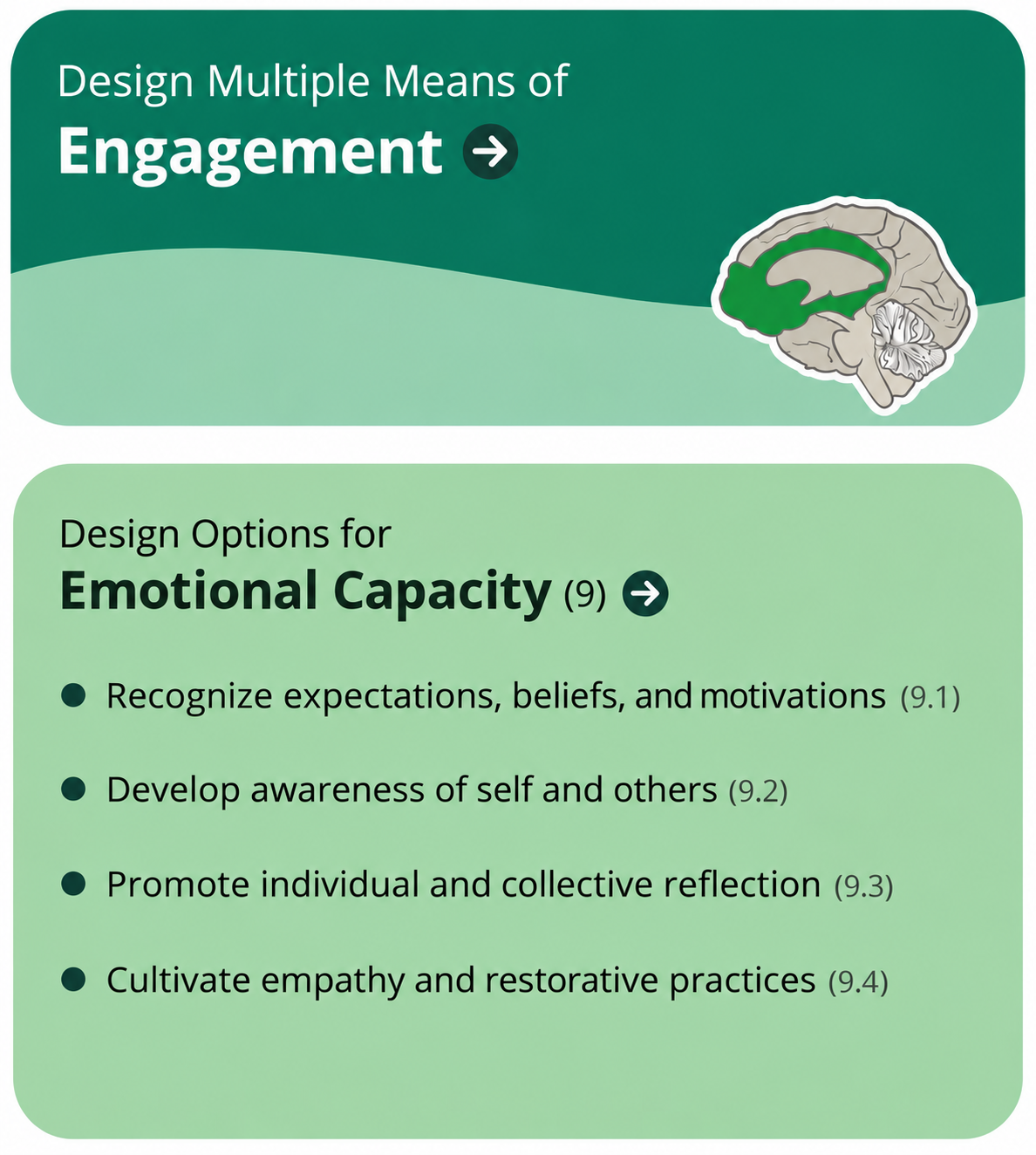
In UDL 3.0, "emotional capacity" refers to the psychological bandwidth a student has available to process frustration, manage performance anxiety, and sustain focus under pressure. Motivation and emotional bandwidth are not fixed traits and fluctuate continuously under environmental stress, fatigue, and other external demands (CAST, 2024b). The UDL 3.0 update addresses these realities directly by replacing previous self-regulation recommendations with the explicit strategy in Guideline 9: "Design Options for Emotional Capacity" (see Figure 1). The update also connects emotional capacity with "Optimizing Challenge and Support" (CAST, 2024c).
Instead of assuming students bring a steady reserve of grit to class every day, UDL 3.0 prompts instructors to design flexible supports into the learning environment by incorporating adjustable challenge levels with opportunities for self-regulation. Introducing flexible supports like these can help students maintain engagement even when external stressors start to drain their mental energy (Consideration 8.2 & Consideration 9.1).
Here are a few cross-disciplinary examples of adjustable challenge levels and flexible self-regulation supports:
- Physics / Calculus (Tiered Entry-Point Problem Sets): Homework problem sets offer tiered challenges where students start with basic conceptual applications before moving to more complex multi-step derivations. Students low on mental bandwidth on a given day can build momentum by working on foundational problems before tackling more advanced variations.
- Nursing / Health Sciences (Simulation Recovery Debriefs): Following high-stakes clinical simulations, instructors implement structured self-reflection that intentionally frames errors as diagnostic learning opportunities. This type of reflection can help students regulate performance anxiety and maintain focus during subsequent clinical rounds.
- Data Science / Statistics (Progressive Challenge Milestones): Coding labs feature self-paced challenge checkpoints with explicit solution hints available after two independent attempts, helping students regulate their frustration threshold and sustain persistence without giving up. For example, in a Jupyter Notebook coding lab, after two failed attempts to filter a dataset, a conceptual hint suggests how to handle missing values before revealing the complete solution code.
Multiple Means of Representation: Offloading Working Memory Load
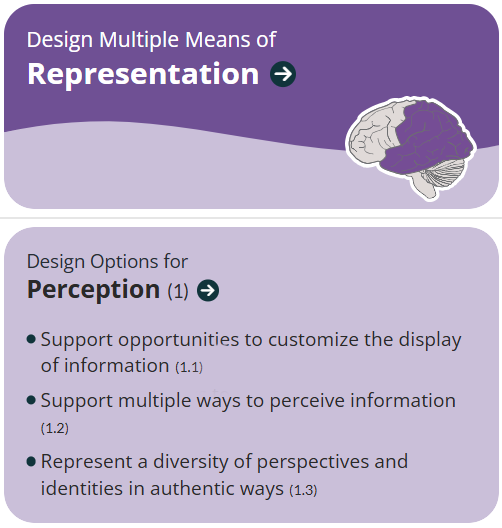
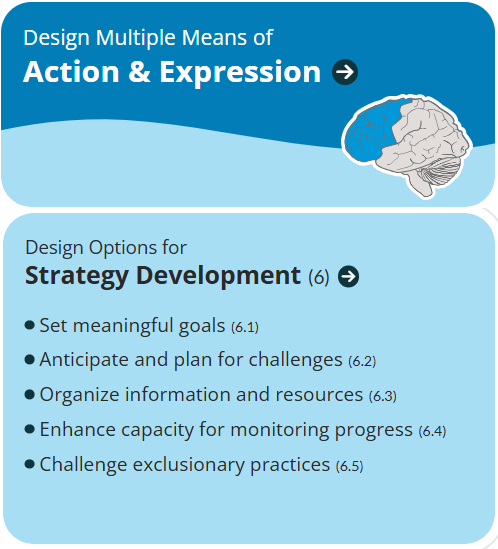
Working memory is a cognitive resource that can bottleneck when students process a lot of new or complex information (Sweller, 2011). This kind of overload can also occur when course materials present information in dense, less-organized formats. In either case, the reduced mental bandwidth may negatively impact deeper conceptual understanding. In keeping with UDL 3.0's "Design Options for Perception" and "Building Knowledge" (see Figure 2), instructors can help students offload some of this cognitive load by providing multimodal content, scaffolded graphic organizers, and explicit structural cues (Consideration 1.1 & Consideration 3.2).
Here are a few cross-disciplinary examples of reducing working memory load:
- Organic Chemistry (Dual-Coded Molecular Diagrams): Complex reaction mechanisms pair 3D interactive molecular visualizations with concise step-by-step text descriptions. Distributing information across visual and verbal channels prevents bottlenecking in working memory.
- Art History (Scaffolded Concept Maps): Multi-page reading assignments are accompanied by visual organizers like digital concept maps and timelines that help students anchor key historical movements and themes before diving into denser textual content on the topic.
- Economics & Finance (Segmented Video & Lecture Chunking): Complex microeconomic models are broken into 5- to 7-minute video modules with interactive learning checks to regulate cognitive load and help students work through each part of the model step by step.
Plus-One Challenge: Designing for Change
Now that we've seen how multiple factors can impact learning capacity, try implementing one of the following "Plus-One" UDL design changes to help support motivation, reduce cognitive load, or guide executive functioning in your course.

Try picking one of the following UDL design changes to implement this semester!
1. Provide a Planning Template
For major term projects or research papers, provide an optional planning calendar or task-outline template that guides executive functioning by breaking down the assignment into manageable sub-tasks with estimated completion times.
Sample Template Structure
"Step 1: Draft thesis & find 3 sources (Target: Week 4); Step 2: Outline main arguments using provided matrix (Target: Week 6); Step 3: Peer review draft (Target: Week 8)."
2. Implement Multimodal Content Summaries
Identify one module with heavy conceptual reading and pair it with a visual diagram, concept map, or short audio summary to help reduce working memory constraints.
Example Application
In a political science unit on institutional checks and balances, pair 20 pages of primary text with a single-page visual flowchart showing constitutional power flows.
3. Build in Low-Stakes "Retrieval Practice" Warmups
Begin lectures or weekly modules with a 2-minute ungraded quiz or reflection prompt. In UDL terms, this simple routine activates background knowledge (Consideration 3.1) and consolidates long-term memory, reducing cognitive friction before introducing new concepts.
Sample Prompt
"Before we start today's topic, jot down two key takeaways from last week's reading on supply chain bottlenecks."
4. Offer "Grace Tokens" for Flexible Self-Pacing Windows
Acknowledge shifting life circumstances and energy fluctuations by giving students two no-questions-asked 24-hour extensions per semester. In Canvas, there are several ways this can be accomplished. One way might involve creating a simple “Grace Token Request” assignment where students indicate which assignment they want to extend. The instructor then applies a 24-hour individual due-date extension to that assignment and records the student's remaining tokens.
Syllabus Policy Sample
"Because mental bandwidth varies and life happens, you'll get two 'Flexible Deadline Tokens' this semester. You can submit an extension request via the Canvas Grace Token Assignment prior to the due date to grant yourself a 24-hour extension without penalty."
Designing for the Dynamic Brain
Moving beyond assumptions about more prescribed "learning styles" helps us design courses better suited to how our students' brains actually work in the real world. From a UDL perspective, when we build executive function scaffolds into Action & Expression, reduce working memory bottlenecks in Representation, and support fluctuating emotional capacity in Engagement, our courses become more resilient when student energy and bandwidth inevitably dip or shift. In the end, designing for the dynamic brain is about ensuring our learning environments remain responsive enough so that every student can meet high academic standards, no matter what kind of day they're having.
Up Next: "Co-Designing for Learner Agency in UDL Guidelines 3.0"
Our fourth and final UDL 3.0 miniseries Tip of the Month article, "From Passive Options to Shared Ownership: Co-Designing for Learner Agency," will explore how UDL 3.0 shifts the framework's endgame from educator-driven choices toward greater student agency. In this context, we'll look at practical UDL strategies for co-creating assessments, sharing course decisions, and empowering students to select and reflect on their learning pathways.
References
- CAST. (2024a). About the Guidelines 3.0 update. https://udlguidelines.cast.org/more/about-guidelines-3-0/
- CAST. (2024b). Design options for emotional capacity. https://udlguidelines.cast.org/engagement/emotional-capacity
- CAST. (2024c). Optimize challenge and support. https://udlguidelines.cast.org/engagement/effort-persistence/challenge-support/
- Gravel, J. W., & Novak, K. (2024). UDL Guidelines 3.0: A community-driven, research-based process toward fulfilling the promise of Universal Design for Learning. International Journal of Universal Design for Learning. https://journals.imist.ma/index.php/IJUDUDL/article/view/6592/5809
- Howard-Jones, P. A. (2014). Neuroscience and education: Myths and messages. Nature Reviews Neuroscience, 15(12), 817–824. https://doi.org/10.1038/nrn3817
- Pashler, H., McDaniel, M., Rohrer, D., & Bjork, R. (2008). Learning styles: Concepts and evidence. Psychological Science in the Public Interest, 9(3), 105–119. https://doi.org/10.1177/1529100610387057
- Rao, K., Gravel, J. W., Rose, D. H., & Tucker-Smith, T. N. (2023). Universal Design for Learning in its 3rd decade: A focus on equity, inclusion, and design. In R. J. Tierney, F. Rizvi, & K. Ercikan (Eds.), International Encyclopedia of Education (4th ed., Vol. 6, pp. 712–720). Elsevier. https://doi.org/10.1016/B978-0-12-818630-5.14081-1
- Rose, D. H., & Meyer, A. (2002). Teaching every student in the digital age: Universal Design for Learning. Association for Supervision and Curriculum Development.
- Sweller, J. (2011). Cognitive load theory. In Psychology of learning and motivation (Vol. 55, pp. 37–76). Academic Press. https://doi.org/10.1016/B978-0-12-387691-1.00002-8
- Thompson, M. (2024). Building bridges: UDL and instructional scaffolding. CITL Tip of the Month. https://citl.illinois.edu/udl-tip-month-2024
- Thompson, M. (2026a). Centering the "Who" of learning: An introduction to UDL Guidelines 3.0. CITL Tip of the Month. https://citl.illinois.edu/udl-tip-month-2026
- Thompson, M. (2026b). Longing for belonging: Unpacking the new inclusivity focus in UDL Guidelines 3.0. CITL Tip of the Month. https://citl.illinois.edu/udl-tip-month-2026